Father Jacobus
The Glass Bead GameFather Jacobus, the foremost historian of the Benedictine Order, becomes Joseph Knecht’s friend and teacher at Mariafels. Their exchange changes Knecht’s understanding of history and of his own place in the world, while gradually transforming Jacobus’s suspicion of Castalia into respect and support for cooperation between the two Orders.
Identity and First Meetings
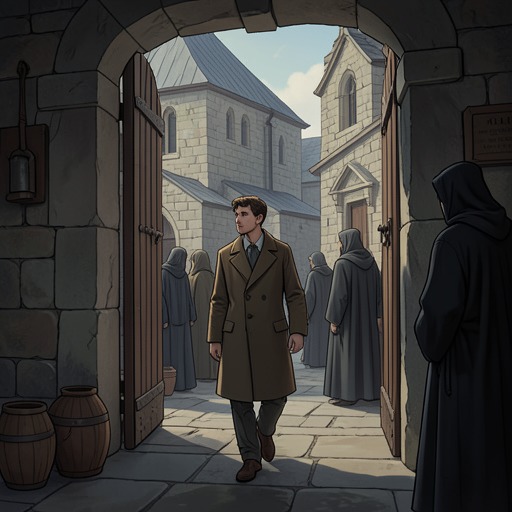
About sixty when Knecht encounters him, Father Jacobus is a spare, elderly scholar with a striking profile and a quiet manner that can prove unexpectedly lively. He works at a table in a small room off the monastery library, where his books and concentration give the room the air of a private domain. Although Mariafels contains precious books, he appears to be its only seriously active scholar. Knecht initially knows him at a distance; it is the novice Anton’s evident reverence for the old man that prompts Knecht to notice him and learn that he is a leading authority on Benedictine history.
Jacobus approaches Knecht in a low, precise voice and invites him to visit after vespers. He says plainly that he is neither a specialist on Castalia nor a player of the Glass Bead Game, but that the increasingly close ties between their very different Orders make him unwilling to exclude himself from an exchange. The invitation establishes the terms of their relationship: neither man is simply a representative speaking for an institution. Their conversations become a personal encounter between a Benedictine historian and a young Castalian whose education has not prepared him for Jacobus’s field.
History as a Discipline of Reality
Their friendship begins with music and historical discussion. Knecht first hears Jacobus playing a Purcell sonata in his rooms; their subsequent conversation ranges from music and Benedictine artistic traditions to the history of the Order. Jacobus admits that Castalian history has scarcely interested him and criticizes the Castalian Order as an imitation of Christian models without religion, God, or Church. Knecht answers respectfully that other traditions have understood religion and spiritual life differently, and that Castalia’s intentions and influence cannot simply be dismissed. Their disagreement is frank from the outset, but it makes room for mutual instruction rather than closing it down.
Jacobus’s central challenge is that Castalian scholarship can mistake its orderly abstractions for the reality they are meant to describe. He argues that historians must organize evidence, as every science does, but must not let a pre-existing pattern erase the particular truth of events. His example is an anatomist who sees only the expected arrangement of organs and ignores the unique body before him: such a scholar, Jacobus says, has become a Glass Bead Game player in the wrong field. History requires submitting to chaos while retaining faith in order and meaning. The work is necessary and serious precisely because historical reality cannot be made fully manageable by method.
That lesson becomes a turning point in Knecht’s development. From Jacobus he learns both the laws and contradictions of historical study and historiography, and to see the present, including his own life, as historical reality. The knowledge is not just an additional scholarly subject: it unsettles a Castalian education that has made the past seem remote and history largely a matter of ideas. Knecht later identifies his apprenticeship under Jacobus as the beginning of his love for a wider, changing world, a love for which Castalia, in its self-contained perfection, offers little nourishment.
Reciprocal Teaching and Difficult Trust
The two men’s instruction runs in both directions. Jacobus teaches Knecht Benedictine history, the early Middle Ages, epigraphy, and the use of historical sources. Knecht introduces Jacobus to Castalia’s history and structure and to the principles of the Glass Bead Game. A special reading hour brings them to an old chronicler in the original; Jacobus permits Anton to attend those readings, though he persuades Knecht that a third person would hinder the more private work of their lessons. In their sessions Knecht is at once pupil and teacher, while Jacobus listens closely and questions him critically.
The exchange does not erase Jacobus’s distrust. He doubts that an Order without a religious foundation can cultivate a kind of human being he considers fully serious, and he continues to regard the Game as a game, however much its practitioners seek to raise it toward sacrament. He also criticizes Castalians for knowing their own specialized intellectual culture better than humanity in its wider range, including its embodied and historical realities. Knecht takes the attacks calmly, resisting them when Jacobus’s passion carries him too far, but admits that some criticisms strike home. The tension makes their friendship intellectually consequential: Jacobus is not won over by politeness, and Knecht cannot defend Castalia without examining its limits.
Over the course of roughly two years, Jacobus’s response changes slowly. At first, he uses Castalian and Game-player as words of irony or reproach. Knecht’s personality and teaching gradually lead him toward a more tolerant, then respectful, acceptance of Castalia as another attempt to cultivate a spiritual elite. Jacobus ceases to dismiss the Game as mere aesthetic dandyism and no longer rules out friendship or alliance between Orders divided by a great difference in age. The narrative presents this growth as cautious and gradual rather than as a complete conversion; even after he becomes willing to recommend rapprochement, his distrust of Castalian mentality never wholly disappears.
Diplomatic Candor and Institutional Consequences
Knecht’s private friendship with Jacobus is also entangled with an official purpose: he has been sent to win Jacobus’s support for closer relations between Castalia and Rome. As the lessons deepen, Knecht becomes troubled that Jacobus is giving him time and trust while remaining unaware of the diplomatic assignment. Before Knecht can disclose it, Jacobus recognizes that the purpose of his guest’s stay has become clear and directly asks whether the assignment concerns him. Knecht confirms that it does and is embarrassed that Jacobus has had to bring the matter into the open. Jacobus reassures him: their exchange has benefited him, and he sees no need for Knecht to defend the purity of his motives. The moment allows their relationship to accommodate both genuine affection and political purpose without pretending the latter was absent.
Their work has consequences beyond the two men. Knecht’s effort to explain Castalia forces him to study its constitution, elite schools, and history more closely, and exposes how schematic his own understanding is of the circumstances that produced the Province. Jacobus, in turn, helps him connect Castalian development to the history of nations. Their passionate disputes thus reshape both men’s knowledge: Jacobus learns to understand the institution he had dismissed, while Knecht learns that his own tradition cannot be properly understood outside the wider historical world.
The resulting rapprochement unfolds over time, not as a single negotiated settlement. Through Jacobus’s growing knowledge and advocacy, relations between Rome and Castalia move from suspicion toward benevolent neutrality, scholarly exchange, occasional cooperation, and ultimately concord. Jacobus asks to learn the theory of the Glass Bead Game, recognizing it as central to the Order’s spiritual identity, though he is too old to become a player. He nevertheless becomes one of the Game and the Order’s most earnest and influential friends beyond Castalia. His role is therefore both personal and institutional: he does not become a Castalian, but helps make cooperation possible without dissolving the differences between the communities.
Farewell, Memory, and Legacy
Music remains a private language of their friendship. After strenuous study and tense argument, Knecht sometimes brings a clavichord or violin to Jacobus’s room, where they play together or in turn at the piano. In a later farewell, Knecht plays a movement from the Purcell sonata Jacobus loves. The guest’s face brightens, though his eyes fill with tears as the friends say good night. The scene returns to the sonata that had first drawn Knecht to Jacobus’s door, giving their relationship a quiet formal shape: music opens their acquaintance and accompanies its parting.
Jacobus’s influence continues after his death. When Knecht weighs leaving his high office and Castalia, he imagines that the authorities may offer him a stay in Mariafels, where Jacobus has recently died, or in Rome, rather than release him. Later, explaining his departure, Knecht credits his awareness of the world beyond Castalia first to Plinio Designori and then, above all, to his time among the Benedictines and to Jacobus, who gave him an inkling of history. Even during his final meditations, Knecht wishes he could speak with Jacobus about whether awakening means discovering truth or proving oneself through decisions in the real world. Jacobus remains, in memory, not merely the teacher of a subject but the interlocutor against whom Knecht tests the meaning of action, service, and historical responsibility.
The novel also preserves Jacobus’s warning about times of terror and misery: whatever happiness can be drawn from them must be spiritual, grounded in preserving the culture of earlier times and defending the life of the spirit against material power. Knecht includes the remark in a memorandum to the Board, making the historian’s voice part of his argument about Castalia’s future. Jacobus’s legacy therefore joins intellectual criticism to practical solidarity: he teaches Knecht to distrust a history without reality, yet his own work helps protect the spiritual institution whose limits he never stops discerning.